
Churchgoers remain confident in their ability to understand and explain the Bible, but a growing number believe the truths of the Scripture have lost relevance.
Nine in 10 U.S. Protestant churchgoers (91%) believe they can read a passage of the Bible and usually understand how it is relevant to them, according to a study from Lifeway Research. Around 4 in 5 express confidence in their ability to address others’ concerns or questions about the Bible in various situations.
Yet, most (56%) say they find it challenging to make sense of the Bible when they read it on their own. Additionally, an increasing minority accept only some truths from the Bible and believe others have become obsolete.
“Most churchgoers enjoy trying to understand the Bible, but some are selective in what they believe in the passages they read,” said Scott McConnell, executive director of Lifeway Research. “Jesus invited people to follow Him and He said, ‘If anyone loves me, he will keep my word,’ (John 14:23, CSB). And He instructed His disciples to teach new followers ‘everything I have commanded you,’ (Matthew 28:20). His invitation was for the whole, not parts.”
Biblical confidence
Almost all U.S. Protestant churchgoers (95%) say they enjoy exploring a passage of Scripture to understand what it means, including 62% who strongly agree. A similar number (91%) believes they can read a passage and usually understand how it is relevant to them.
Churchgoers aren’t only confident in their ability to understand the Bible themselves. They also believe they can help others’ doubts and confusion.
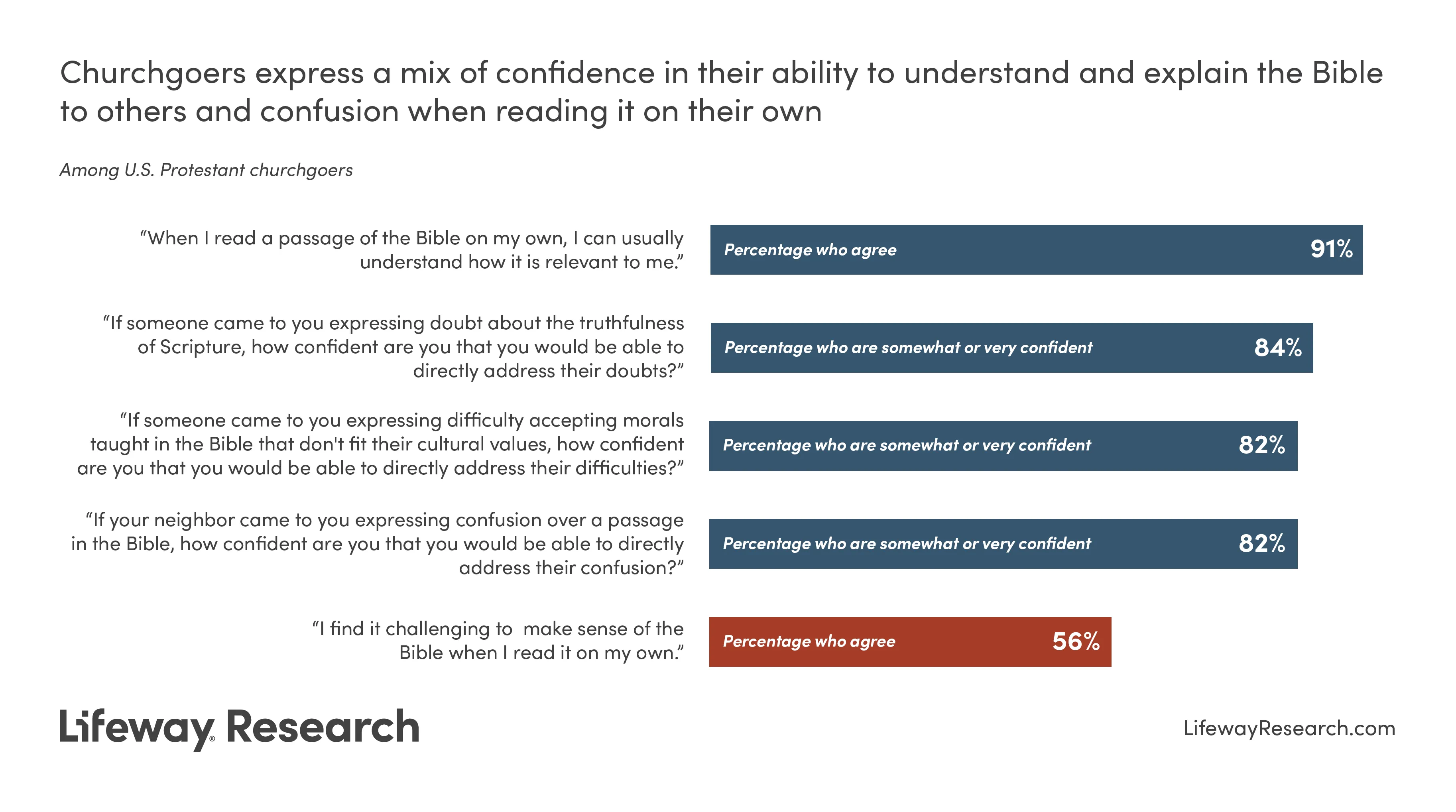
More than 4 in 5 believe they could address someone’s doubts about the truthfulness of Scripture (84%), someone’s difficulty accepting morals taught in the Bible (82%) and someone’s confusion over a passage in the Bible (82%).
“While large numbers are confident they can address various difficulties others have with the Bible, less than a third of churchgoers strongly agree,” said McConnell. “This is likely tied to their evaluation of their own ability to understand passages and relate them to life. Only 38% strongly agree they can do this, while the majority (53%) only somewhat agree.”
In general, those who attend church more frequently and those with evangelical beliefs are more confident in their ability to help others better understand the Bible.
Despite the confidence to help others, most churchgoers (56%) admit they find it challenging to make sense of the Bible when they read it on their own. More than 2 in 5 (43%) disagree, and 1% aren’t sure.
Those who attend less frequently and those at the smallest churches are the most likely to agree making sense of the Bible on their own is a challenge. Churchgoers who attend a worship service one to three times a month are more likely to agree than those who attend four times a month or more (62% v. 52%). Also, those at churches with fewer than 50 in attendance (65%) are among the most likely to agree.
Additionally, women are more likely than men to say they find it hard to interpret the Bible when reading alone (61% v. 51%).
Questioning Scripture
In all their confidence to explain the Bible to others, most churchgoers believe Scripture can have different meanings for readers. Four in 5 (82%) believe the truth of God’s Word can mean different things to different people, including 38% who strongly agree. Around 1 in 6 (16%) disagree, and 2% aren’t sure.
Those without evangelical beliefs are more likely to agree than those with such beliefs (90% v. 75%). Denominationally, Restorationist movement churchgoers (96%) and Methodists (92%) are more likely to agree than Baptists (80%), Presbyterian/Reformed (79%) or non-denominational churchgoers (77%).
Additionally, some churchgoers disregard truths from the Bible because they don’t fit with their personal beliefs or cultural changes. Both of those beliefs have increased since a 2019 Lifeway Research study.
Seven years ago, 30% said they accepted some truths from the Bible but others don’t fit what they believe. That’s now up 4 percentage points (34%). Similarly, in 2019, 24% believed that as culture changes, some biblical truths become obsolete. Today, that has also climbed 4 percentage points (28%).
“The concepts in any other book will show signs of age requiring new editions. But the Source of the Bible is not Someone whose truths change. James refers to Him as ‘the Father of lights, who does not change like shifting shadows,’ (James 1:17, CSB). The thought of unchanging truth is an unprecedented concept even for many churchgoers today,” said McConnell.
Younger churchgoers often have the most hesitancy around the Bible remaining consistent and true for every person. Those 18-29 are among the most likely to say the truth of God’s Word can mean different things to different people (87%) and some biblical truths don’t fit what they believe (56%).
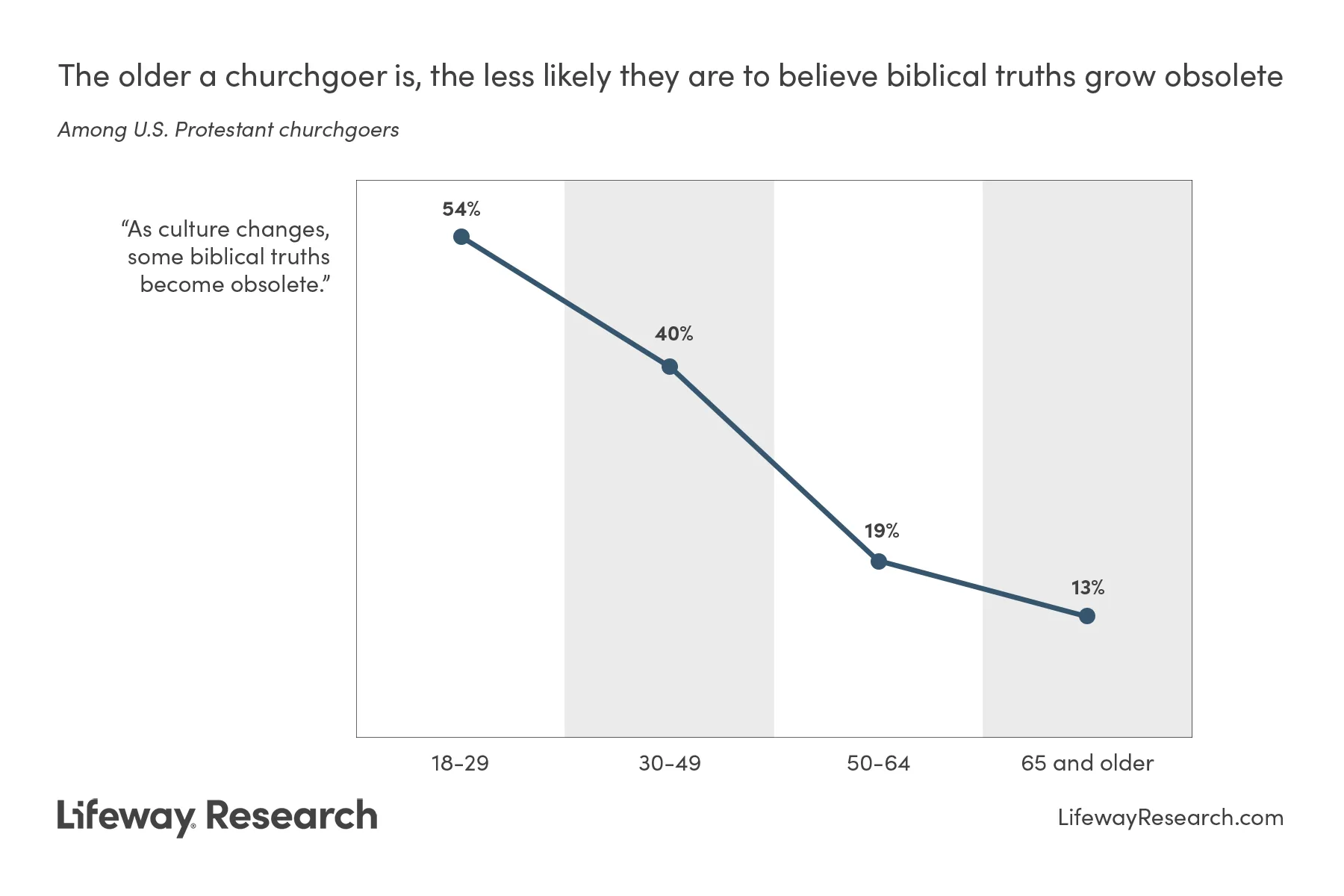
The younger a churchgoer is the more likely they are to see some truths from the Bible as obsolete. Those 18-29 (54%) are the most likely to agree, followed by those 30-49 (40%), 50-64 (19%) and 65 and older (13%).
Additionally, churchgoers at the largest congregations are the most likely to hold to the consistent relevancy and truthfulness of Scripture.
Those at churches with attendance of 500 or more are the most likely to disagree that some biblical truths become obsolete (84%) and among the most likely to disagree the truth of God’s Word can mean different things to different people (25%). They are among the least likely to agree that some truths from the Bible don’t fit what they believe (19%).
Men are more likely than women to say some biblical truths don’t fit their beliefs (40% v. 29%).
Interpreting and applying God’s Word
Churchgoers say context matters for both interpretation and application of the Bible, but some have grown less sure.
Almost all (96%) agree it’s important to understand the context in which the Bible was written, including 67% who strongly agree. In 2019, the overall percentage was the same (96%), but those who strongly agreed was higher (73%).
Similarly, 92% of current churchgoers say it is important to apply the meaning and principles of Scripture to today’s context, including 60% who strongly agree. Seven years ago, however, of the 93% who agreed, 66% did so strongly.
“We live in a re-mix world in which people apply phrases, pictures, tunes and memes to situations that may have nothing to do with the originals. AI often pulls from past content in the same way. That may work for a laugh or to make something sound familiar. But the value of biblical principles is not to sound good,” said McConnell. “The message of the Bible was revealed to specific people in contexts we need to understand to know how that message applies to us today.”
For more information, view the complete report and visit LifewayResearch.com.
Methodology
The online survey of 1,200 American Protestant churchgoers was conducted Sept. 2-7, 2025, using a national pre-recruited panel. Respondents were screened to include those who identified as Protestant/non-denominational and attend religious services at least once a month. Quotas and slight weights were used to balance gender, age, region, ethnicity, education and religion to more accurately reflect the population. The completed sample is 1,200 surveys. The sample provides 95% confidence that the sampling error from the panel does not exceed plus or minus 3.2%. This margin of error accounts for the effect of weighting. Margins of error are higher in sub-groups. Comparisons are made to an online survey of 1,002 churchgoers using the same methodology conducted Sept. 20-27, 2019.
Evangelical beliefs are defined using the NAE/Lifeway Research evangelical beliefs research definition based on respondent beliefs. Respondents are asked their level of agreement with four separate statements using a four-point, forced choice scale (strongly agree, somewhat agree, somewhat disagree, strongly disagree). Those who strongly agree with all four statements are categorized as having evangelical beliefs.
- The Bible is the highest authority for what I believe.
- It is very important for me personally to encourage non-Christians to trust Jesus Christ as their Savior.
- Jesus Christ’s death on the cross is the only sacrifice that could remove the penalty of my sin.
- Only those who trust in Jesus Christ alone as their Savior receive God’s free gift of eternal salvation.