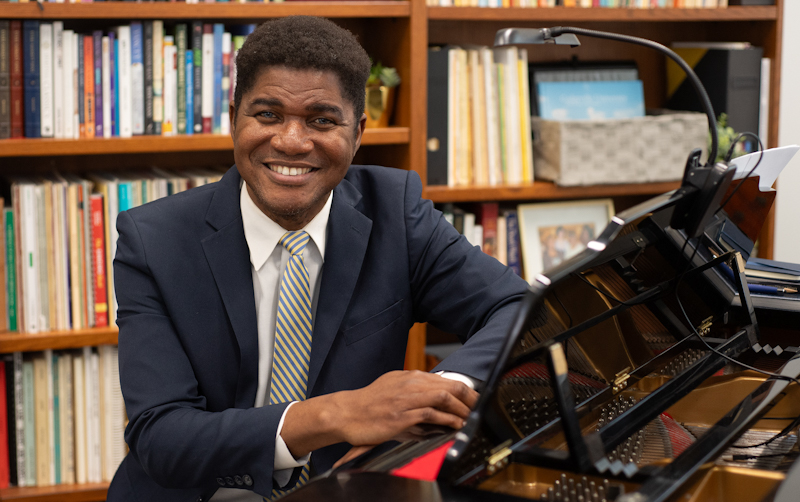
The words were written in French on a classroom blackboard in Haiti: “L’espoir fait vivre” — “hope makes one live.”
For Dr. Lou Lilite, a professor of music at Cedarville University, that lesson has never been abstract. It is a way of seeing, a reminder that behind every headline and every label is a person trying to take the next breath with dignity.
Springfield Haitian Community Faces Uncertainty Over Humanitarian Parole
Less than 15 miles from Cedarville University, in Springfield, Ohio, a large Haitian community is doing exactly that. Many are in the United States legally, but some are living with persistent uncertainty as the humanitarian parole program is debated in court. The legal terms can feel technical from a distance. Up close, Lilite said, they weigh on families in ordinary, personal ways.
“It’s like this erosion that takes place inside a person,” said Lilite. “It negatively impacts their creativity … the ability to breathe properly.”
Cedarville Music Professor Visits Haitians as a Neighbor, Not a Policy Expert
When he visits Haitians in Springfield, he does not go as a policy expert. He goes as a neighbor. Sometimes, he sits and listens. Other times, he answers questions about unfamiliar systems — why taxes exist, how paperwork should be completed or what a process means. Often, he said, what people need first is simple: to be seen.
Seeing Immigrants Beyond Labels in Public Debate
He understands the need for laws and order. But he has also watched how quickly public conversations can reduce immigrants to categories or a set of labels and talking points that leave no room for the complexity of a human life.
“There are real humans behind each label,” said Lilite. “There are real people with real problems, with real stories, with real circumstances. There is a soul.”
From Northern Haiti to Cedarville: Lou Lilite’s Immigration Story
Lilite’s insistence on seeing people has roots in his own story. Now a naturalized U.S. citizen, he grew up in a Christian pastor’s home in the mountains of northern Haiti, where his parents served as home missionaries and taught their children to love Christ and the gospel. In school, he said, teachers offered more than lessons. They offered hope, posting quotes that pushed students to imagine beyond their immediate circumstances.
As his love for music grew, Lilite realized the training he wanted was not available to him in Haiti. He pursued education in the United States, but getting here required time and perseverance. His family wanted to do things legally, and it took 13 applications over two and a half years before he was granted an immigrant visa.
Later, as an international student on an F-1 visa, he faced limits that shaped his everyday life. Some semesters, he said, the pressure showed up in simple choices, like how far a meal plan could stretch. He remembers thinking, “I don’t think I can afford more than a five-meal plan” — five meals a week — and learning how to make careful decisions so he could get through the semester.
That personal memory helps him understand the strain many Haitian immigrants carry today, including those who have tried for years to do everything “the right way.” Lilite recalled a family he knows who began the legal process 15 years earlier, submitting every required document and waiting — and waiting. When the humanitarian parole option opened, they used it not because it was ideal, he said, but because it felt like the only remaining open door. Years later, they are still waiting.

Compassion in Immigration Conversations: “Suffering With” Others
For Lilite, compassion begins where slogans end. He describes it as more than sympathy or online commentary. Compassion, he said, is “suffering with” someone. It is being close enough to listen, patient enough to learn and faithful enough to keep showing up.
He also believes Americans face what he called a kind of “relational poverty,” a habit of distance that makes neighborliness harder than it should be. “We live behind screen doors and garage doors,” said Lilite, “moving in and out without learning who lives nearby.”
As the nation continues to debate programs and status, Lilite hopes people remember what his old classroom blackboard taught him: Hope is not a slogan. It is what helps someone live, and it is often sustained, one conversation at a time, when someone chooses to see a person rather than a label.
Editor's note: Temporary Protected Status (TPS) is a U.S. humanitarian immigration program that lets nationals from countries experiencing war, disaster, or unsafe conditions legally live and work in the United States without fear of deportation. Haiti’s TPS designation dates back to crises including the 2010 earthquake and ongoing instability, and it has allowed many Haitian immigrants—approximately 15,000 in Springfield, Ohio — to build lives, work legally, and contribute to the local economy. TPS holders are protected from removal and can receive work authorization while their country remains designated.
The federal government moved to terminate TPS for Haitians as of February 3, 2026, which would have ended legal status and work authorization for Haitian residents nationwide, including in Springfield. That decision was challenged in court, and a federal judge issued a temporary block on ending TPS while the lawsuit continues, letting Haitians keep their protections for now but leaving long-term status uncertain.
About Cedarville University
Cedarville University, an evangelical Christian institution in southwest Ohio, offers undergraduate and graduate residential and online programs across arts, sciences and professional fields. With 7,265 students, it is among Ohio's largest private universities and is ranked among the nation’s top five evangelical universities in the Wall Street Journal’s 2026 Best Colleges in the U.S. Cedarville is also known for its vibrant Christian community, challenging academics and high graduation and retention rates. Learn more at cedarville.edu.