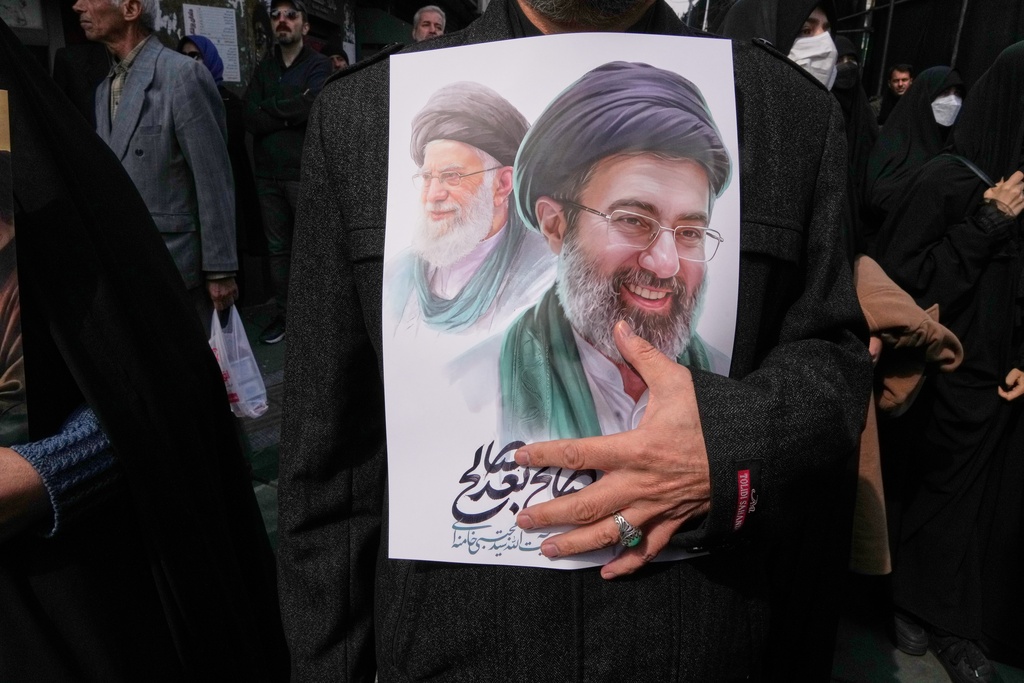
DUBAI, United Arab Emirates (AP) — Iran threatened to target recreational and tourist sites worldwide and insisted it was still building missiles. Its supreme leader issued another defiant statement on Friday, nearly three weeks into U.S.-Israeli strikes that have killed a slew of Tehran’s top leaders and hammered its weapons and energy industries.
The United States was meanwhile deploying three more warships and roughly 2,500 additional Marines to the Middle East, a U.S. official told The Associated Press.
Iranian Supreme Leader Ayatollah Mojtaba Khamenei praised Iranians’ steadfastness in the face of war in a written statement read on Iranian television to mark the Persian New Year, Nowruz.
Khamenei said the U.S. and Israeli attacks were based on an illusion that killing Iran's top leaders could cause the overthrow of the government. He commended Iranians for “building a nationwide defensive front” and “delivering such a bewildering blow that the enemy fell into contradictions and irrational statements.”
Khamenei has not been seen in public since he became supreme leader following the assassination of his father, Ayatollah Ali Khamenei, in Israeli strikes at the start of the war. U.S. and Israeli officials suspect the younger Khamenei was wounded.
Iran’s top military spokesman, Gen. Abolfazl Shekarchi, warned Friday that “parks, recreational areas and tourist destinations” worldwide won’t be safe for Tehran’s enemies. The threat renewed concerns that Iran may revert to using militant attacks beyond the Middle East as a pressure tactic.
A U.S. official confirmed the further buildup of American forces in the region, saying the USS Boxer and two other amphibious assault ships have deployed along with roughly 2,500 Marines. Two other U.S. officials confirmed that ships were deploying, without saying where they were headed.
The war is raising risks to the world economy
Iran’s attacks on energy infrastructure in the Gulf combined with its stranglehold on shipping in the Strait of Hormuz, a strategic waterway through which a fifth of the world’s oil and other critical goods are transported, has raised concerns of a global energy crisis.
U.S. President Donald Trump lobbed fresh insults at NATO allies who have spurned his call for help protecting the strait. U.S. allies have refused to join the war, saying they weren't consulted before the U.S. and Israel launched it. Trump called NATO members “COWARDS” in a social media post, saying: “NATO IS A PAPER TIGER.”
Brent crude oil, the international standard, has soared during the fighting and was around $108 per barrel Friday, up from roughly $70 per barrel before the war began.
Surging fuel prices come at a moment when many world leaders were already struggling to bring down high prices of food and many consumer goods. Asia is getting hit hard as most of the oil and gas exiting the Strait of Hormuz is transported there.
But the price shocks are reverberating throughout the world economy. Key raw materials — like helium used in making computer chips, and sulfur, a raw material in fertilizer — have been obstructed and could be in short supply soon, raising the prices of goods all the way down the supply chain.