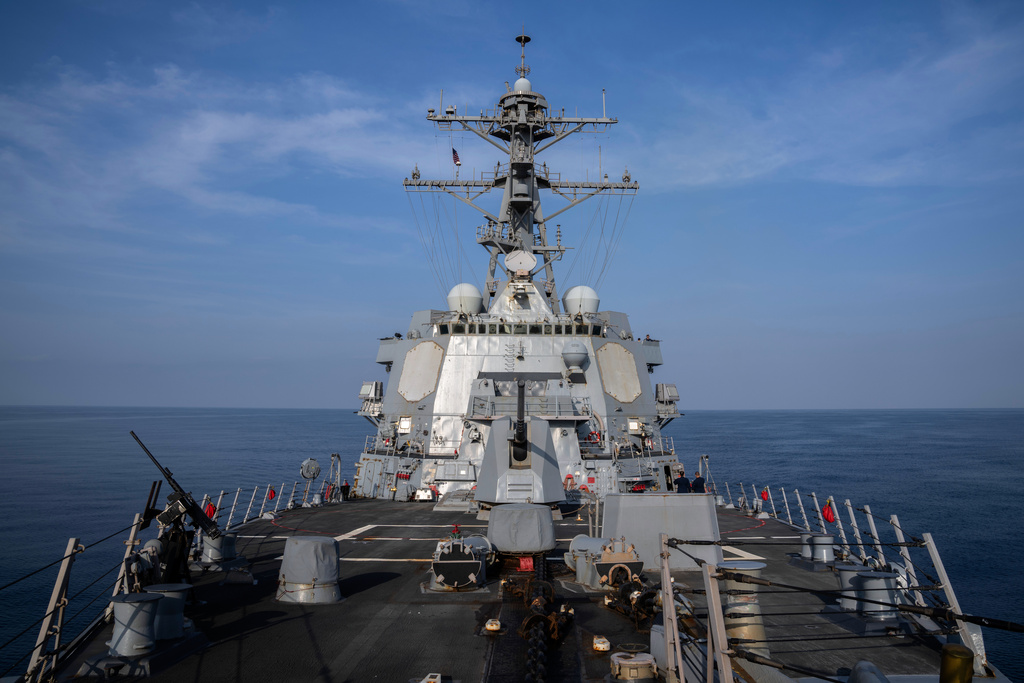
DUBAI, United Arab Emirates (AP) — The U.S. military said it intercepted Iranian attacks Thursday on three Navy ships in the Strait of Hormuz and “targeted Iranian military facilities responsible for attacking U.S. forces.”
U.S. Central Command said in a social media post that U.S. forces intercepted “unprovoked Iranian attacks” and responded with self-defense strikes.
The U.S. military said no ships were hit. It said it doesn’t seek escalation but “remains positioned and ready to protect American forces.”
Meanwhile, Iranian state media said the country’s armed forces exchanged fire with “the enemy” on Qeshm Island in the Strait of Hormuz. It is the largest Iranian island in the Persian Gulf, home to about 150,000 people. It also houses a water desalination plant.
Iranian state media also reported loud noises and defensive fire in western Tehran. In southern Iran, explosions were heard near Bandar Abbas, semiofficial Iranian news agencies said. The reports from the Fars and Tasnim agencies did not identify the source of the blasts.
Iran creates agency to control vessels transiting strait
Earlier Thursday, a shipping data company reported that Iran has created a government agency to vet and tax vessels seeking passage through the crucial Strait of Hormuz, as Tehran said it was reviewing the latest U.S. proposals for ending the war.
The Iranian effort to formalize control over the channel raised new concerns about international shipping, with hundreds of commercial ships bottled up in the Persian Gulf and unable to reach the open sea. Still, hope that the two-month conflict could soon be over buoyed international markets.
Iranian Foreign Ministry spokesperson Esmail Baghaei said the Islamic Republic was reviewing messages from Pakistan, which is mediating peace negotiations, but Iran “has not yet reached a conclusion, and no response has been given to the U.S. side,” Iranian state TV reported.
Meanwhile, U.S. Secretary of State Marco Rubio discussed Middle East peace efforts at the Vatican with Pope Leo XIV, whose opposition to the Iran war has led to open sparring with President Donald Trump.
Administration has sent mixed messages
The Trump administration has sent mixed messages on its strategy to end the war. A tenuous ceasefire and previous declarations that military operations were over have given way to new threats of bombing if Tehran does not accept a deal that allows for resumption of oil and natural gas shipments disrupted by the conflict.
Trump also suspended an attempt by the U.S. military to open a safe passage for commercial ships through the strait, saying the pause would allow more time to reach a peace agreement. An official in Saudi Arabia said Thursday that the kingdom and U.S. ally refused to support Trump's effort to reopen the strait by force.
The ceasefire between the U.S. and Iran has largely held since April 8. But in-person talks between the two countries hosted by Pakistan last month failed to reach an agreement. The war began Feb. 28, when the U.S. and Israel launched strikes against Iran.
Pakistan says it expects a deal soon
Pakistani Foreign Minister Ishaq Dar spoke by phone Thursday with his Iranian counterpart, Abbas Araghchi, the Pakistani Foreign Ministry said.
“We expect an agreement sooner rather than later,” Pakistani Foreign Ministry spokesperson Tahir Andrabi said Thursday. “We hope the parties will reach a peaceful and sustainable solution that will contribute not only to peace in our region but to international peace as well.”
He declined to give a timeline.
Pakistani Prime Minister Shehbaz Sharif, speaking in televised remarks, said Islamabad remained in “continuous contact with Iran and the United States, day and night, to stop the war and extend the ceasefire.”
In other regional developments, direct talks between Israel and Lebanon were scheduled to resume next week in Washington, according to a U.S. official speaking on condition of anonymity to discuss plans for the closed-door meetings. The official said talks will be held May 14 and 15.