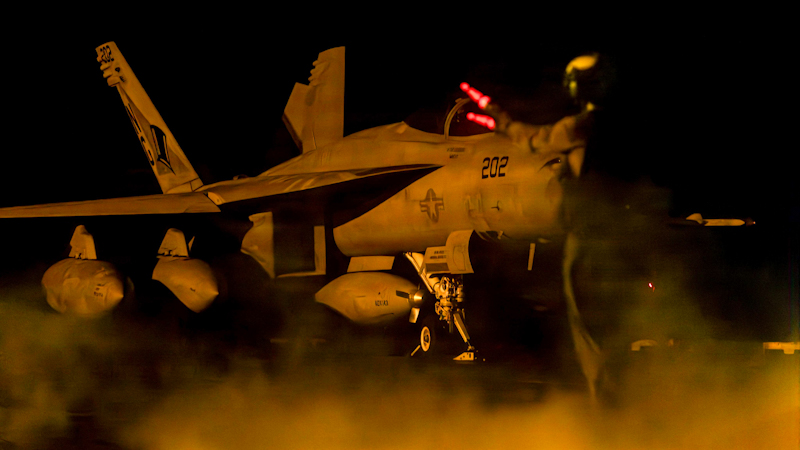
A U.S. fighter jet on Wednesday fired on an Iranian oil tanker in the Gulf of Oman as it tried to breach the U.S. blockade of Iran’s ports, the U.S. military said.
The attack occurred as Iran and the U.S. are officially in a ceasefire and as the two countries seemed to be approaching an agreement to end the war. President Trump threatened Iran with a new wave of bombing if a deal is not reached that includes opening the critical Strait of Hormuz.
Trump posted on social media Wednesday that the two-month war could soon end and that oil and natural gas shipments disrupted by the conflict could restart. But he said that depends on Iran accepting a reported agreement that the president did not detail.
“If they don’t agree, the bombing starts,” Trump wrote.
Israel, meanwhile, struck Beirut’s southern suburbs for the first time since a ceasefire between Israel and the Hezbollah militant group was announced on April 17. Fighting has continued since then in southern Lebanon. A statement released by Prime Minister Benjamin Netanyahu’s office said Wednesday’s strike, which came without warning, targeted a commander in Hezbollah’s Radwan Force.
US military fires on Iranian-flagged oil tanker in Gulf of Oman
An American fighter jet shot out the rudder of an Iranian oil tanker in the Gulf of Oman on Wednesday as it tried to breach the U.S. blockade of Iran’s ports, the American military said in a social media post.
U.S. Central Command:
U.S. forces operating in the Gulf of Oman enforced blockade measures by disabling an Iranian-flagged unladen oil tanker attempting to sail toward an Iranian port at 9 a.m. ET, May 6.
U.S. Central Command (CENTCOM) forces observed M/T Hasna as it transited international waters enroute to an Iranian port on the Gulf of Oman. American forces issued multiple warnings and informed the Iranian-flagged vessel it was in violation of the U.S. blockade.
After Hasna’s crew failed to comply with repeated warnings, U.S. forces disabled the tanker’s rudder by firing several rounds from the 20mm cannon gun of a U.S. Navy F/A-18 Super Hornet launched from USS Abraham Lincoln (CVN 72). Hasna is no longer transiting to Iran.
The U.S. blockade against ships attempting to enter or depart Iranian ports remains in full effect. CENTCOM forces continue to act deliberately and professionally to ensure compliance.
(AP) - The attack occurred as Iran and the U.S. are officially in a ceasefire and as the two countries appear to be moving closer to an initial agreement to end the war. Meanwhile, U.S. President Donald Trump is trying to pressure Tehran with threats of a new wave of bombing if a deal is not reached.
American forces issued multiple warnings and informed the ship it was violating the blockade, U.S. Central Command said in its post.
Trump says question is whether Iran can make a deal ‘that’s satisfactory to us’
The president insisted that Iranian officials want an agreement to end the war, suggesting as he did previously over social media that U.S. actions could ultimately force a settlement.
“We’re dealing with people that want to make a deal very much, and we’ll see whether or not they can make a deal that’s satisfactory to us,” Trump said at a Mother’s Day lunch at the White House.
The president added: “And if they don’t agree, they’ll end up agreeing shortly thereafter.”
Trump called the blockade of the Strait of Hormuz a “wall of steel,” as both countries jockey to use the stoppage in oil and natural gas shipments as a way to pressure the other side.