
The size and location of a church may reveal more than we realize about the discipleship of its churchgoers.
The latest Lifeway Research analysis of State of Discipleship study data finds churchgoers in the smallest and largest congregations, along with those at churches in the South, tend to have higher discipleship scores. Meanwhile, discipleship evaluations look similar from churches in rural areas to those in large cities.
“People can walk with Jesus Christ as disciples in any setting, but some differences we see in where that takes place can indicate where it might be more challenging or more easily encouraged,” said Scott McConnell, executive director of Lifeway Research. “Measuring discipleship is not about making excuses when we fall short. We hope understanding discipleship realities encourages church leaders in different situations to disciple people based on their needs.”
Discipleship scores highest at the smallest and largest churches
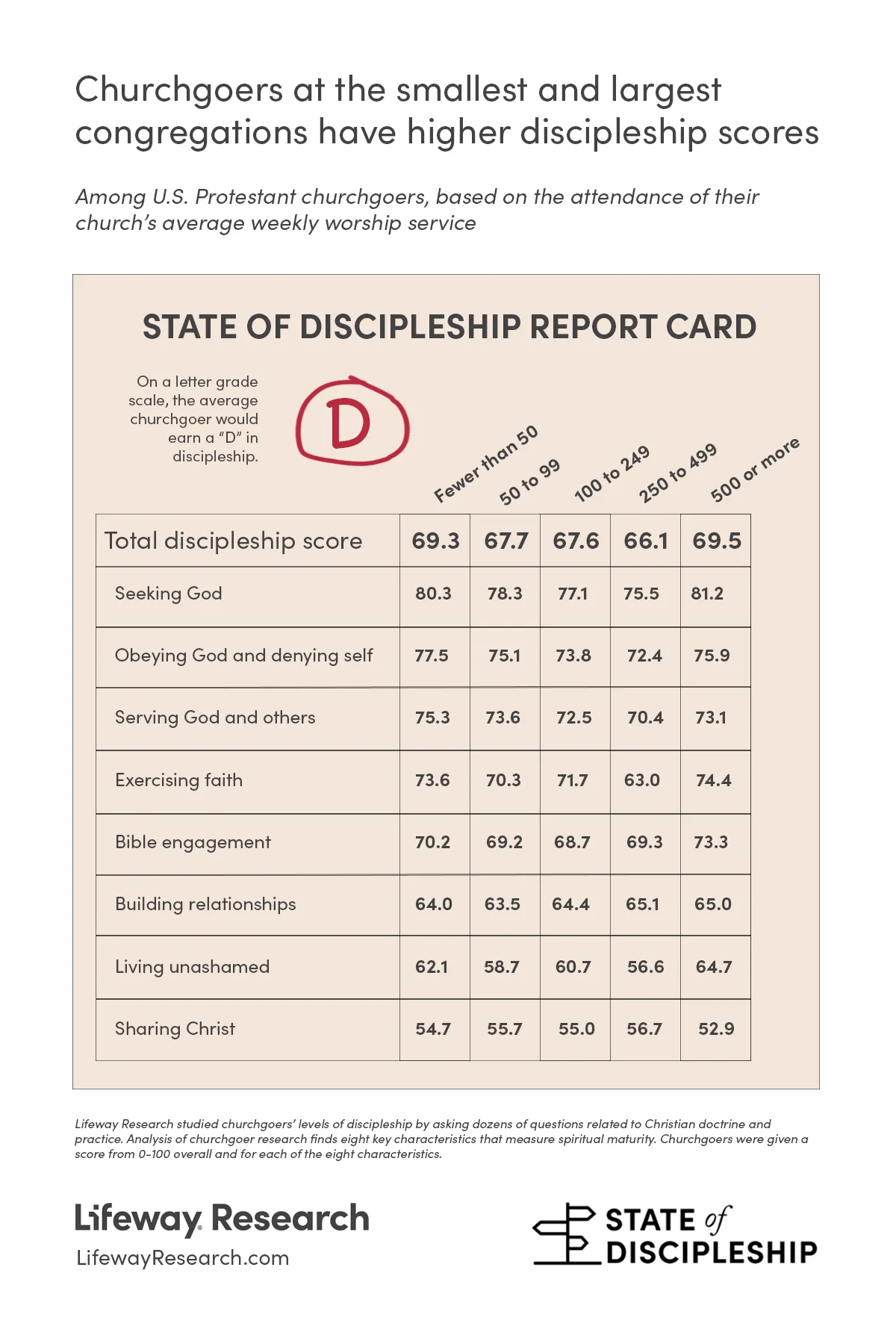
Churchgoers at the smallest and the largest congregations have higher average discipleship scores than those attending mid-sized churches. Those at churches with 500 or more in attendance on a typical weekend (69.5) and those with fewer than 50 in attendance (69.3) have among the highest scores. Churchgoers at congregations of 50-99 score 67.7, those at churches with 100-249 in attendance score 67.6 and those in churches of 250-499 average 66.1.
Specifically, those at the smallest churches are among the most likely to have the highest scores in five of the eight signposts: seeking God (80.3), obeying God and denying self (77.5), serving God and others (75.3), exercising faith (73.6) and living unashamed (62.1). Those at the largest churches are among the most likely to have the highest scores in seeking God (81.2), exercising faith (74.4) and living unashamed (64.7). No significant differences exist across church size for the discipleship signposts of engaging the Bible or sharing Christ.
“Following Jesus Christ is an individual choice, but the people around you in your church are very influential in your choices,” said McConnell. “Different size churches often meet needs in different ways, but the clearest differences related to church size are in opportunities offered, such as mission trips and discipling approaches.”
Churchgoers across all congregation sizes engage in numerous activities at similar rates, including sharing with someone how to become a Christian, inviting someone to church, serving others, fasting, memorizing a Bible verse and visiting the sick. Those at churches with 250-499 attendees are the most likely to have visited people in prison in the last six months (2.0 times on average).
Those at churches of 500 or more in attendance are among the most likely to say they study the Bible every day (21%) and listen to or read teaching about the Bible every day (32%). Churchgoers of those largest churches (63%) and the smallest ones (62%)—those with fewer than 50 in attendance—are the most likely to set aside time for prayer every day.
Church size seemingly plays a role in participation in one-on-one discipleship. Those at a church with 250-499 attendees are more likely than those at most smaller churches to say they have been regularly mentored by a more spiritually mature Christian (49%). Churchgoers at congregations with 250-499 attendees (42%) and those at churches of 500 or more (39%) are among the most likely to have regularly discipled someone less spiritually mature than themselves.
Those at the smallest churches, fewer than 50, are among the least likely to have participated in a mission trip within the United States (17%) or internationally (8%).
While there are no significant differences across congregation size in having regular church responsibilities, those at smaller churches are typically less likely to say their responsibilities include teaching a Bible study group or leading a ministry.
Churchgoers at congregations of fewer than 50 (41%) and 50-99 (45%) are less likely than those at congregations of 250-499 (58%) and 500 or more (59%) to say their regular responsibilities in their church include teaching or facilitating a Bible study. Similarly, those at the smallest churches are among the least likely to say their regular responsibilities include leading a ministry (36%).
“Allegations of large churches having large numbers of people consuming what is offered without serving are only partially true. Sure, the headcount of those sitting and soaking is higher in a large church, but the percentage isn’t. In terms of low rates of attendees serving at church, small churches deserve the same condemnation as large churches,” said McConnell.
Churches in the South top discipleship report card
Evaluating the discipleship status of congregations across the four regions of the United States reveals the South has the highest scores, though the average churchgoer score in every region remains in the 60s. Additionally, those in other regions have their own strengths.
The total State of Discipleship score across the eight signposts is 69.5 for the South, while the other regions are statistically the same: Northeast (66.5), Midwest (66.3) and West (65.2). Those in the South scores the highest or are among the highest across all signposts.
“While the discipleship principles measured in the State of Discipleship come from Scripture, these things are more likely to be emphasized in churches with evangelical teaching. There is a higher concentration of these churches in the South,” said McConnell.
Churchgoers in the West (57%) and South (53%) are the most likely to teach or lead a Bible study group, while those in the South (52%) are among the most likely to lead a ministry.
Those in the South are slightly more likely than those in the Midwest to have shared their faith story with someone in the past six months (5.4 times v. 3.2 times).
Western (46%) and Southern churchgoers (44%) are more likely than those in the Midwest (38%) to have been discipled or mentored one-on-one by meeting regularly with a more spiritually mature Christian. Those in the Midwest (28%) are also the least likely to have met regularly to disciple someone less spiritually mature than them.
Churchgoers in the West are also among the most likely to have participated in a mission trip in the United States (32%) or internationally (19%).
More variety across populations
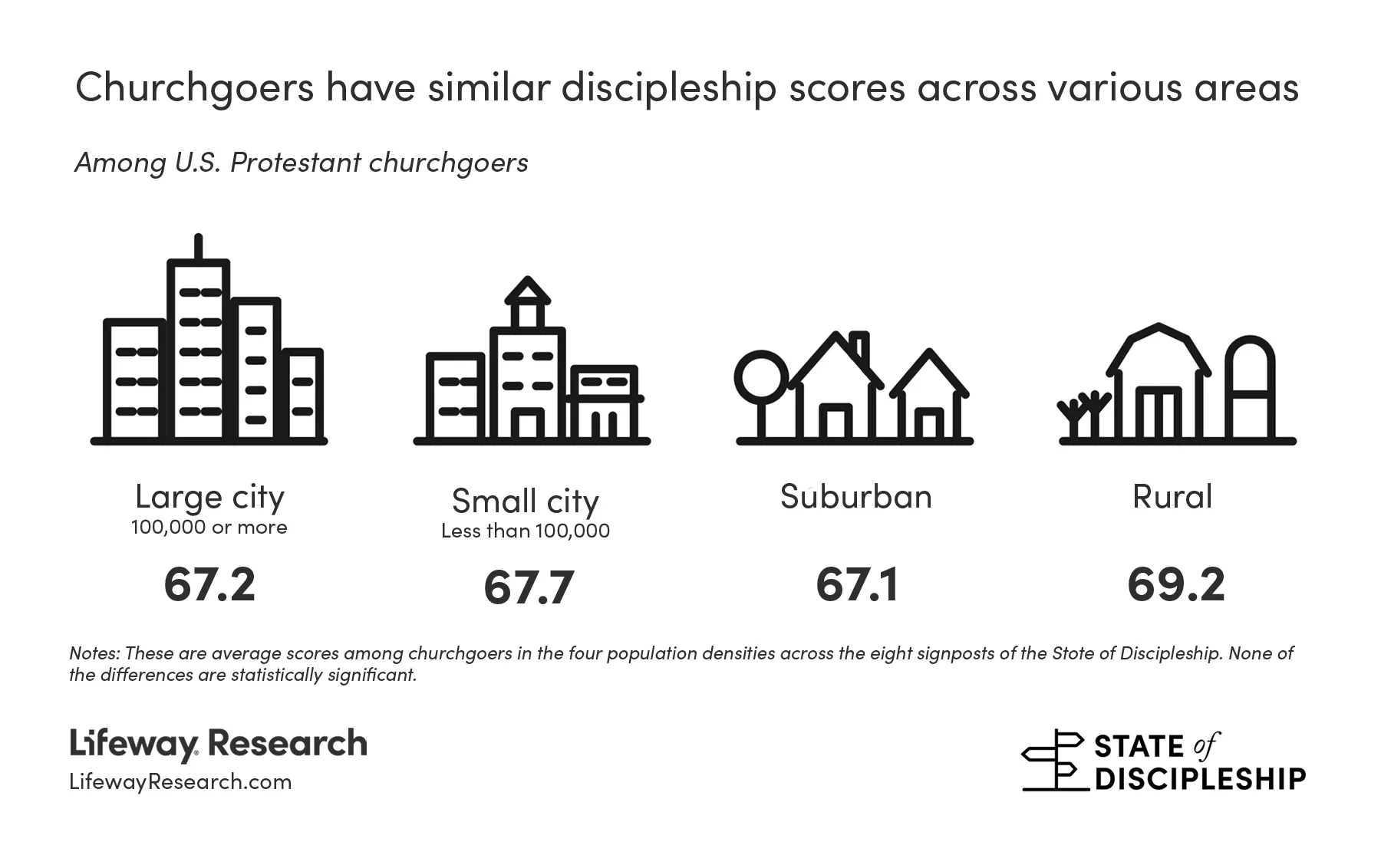
While Southern churchgoers tend to have higher discipleship scores, no single area stands out based on the population density around the church. There are no significant differences in total scores between churchgoers attending congregations in large cities (67.2), small cities (67.7), the suburbs (67.1) or rural areas (69.2).
Within certain signposts, however, some contexts correlate to higher scores. Churchgoers in large cities had the highest scores in sharing Christ (59.9) and a higher score in building relationships (66.8) than those in rural areas (62.6) and the suburbs (61.1). Those in large cities scored higher than those in suburban areas in engaging the Bible (70.9 v. 67.5).
Meanwhile, churchgoers attending in rural areas (78.1) and the suburbs (75.6) have higher scores in exercising faith. Those two areas also stand out in living unashamed (rural: 67.0; suburbs: 64.0).
“As population density rises so do the doubts of churchgoers,” said McConnell. “Individual indicators of a need to grow in exercising faith are two to three times higher for churchgoers in large cities than those in rural areas. But more people in a community often translates to more relationships among churchgoers. And churchgoers in large cities are more proactive in sharing their faith in those interactions.”
Large-city churchgoers are the most likely to say they have been discipled by a more spiritually mature person who met with them regularly to support their spiritual development (56%) and to say they have discipled someone less spiritually mature themselves (47%). They are also the most likely to have participated in a mission trip in the United States (40%) or internationally (27%).
Each month, those in rural areas are the most likely to have made decisions to follow God knowing that it might be costly to them in some way (12.4 times). Rural and suburban churchgoers are the most likely to have been baptized (93%).
In the past six months, large-city churchgoers are also among the most likely to have memorized a Bible verse (6.6), invited an unchurched person to church (4.4), fasted (4.2), visited the sick (4.0) and visited people in prison (2.0). These churchgoers are also among the most likely to say they study the Bible every day (19%), but they are the least likely to say they set aside time for prayer every day (48%).
For more information, visit LifewayResearch.com.
Methodology
The online survey of 2,130 Protestant churchgoers was conducted March 19-26, 2025, using a national pre-recruited panel. Respondents were screened to include those who identified as Protestant/nondenominational and attend religious services at least once a month. Respondents could complete the survey in English or Spanish. Quotas and slight weights were used to balance gender, age, region, ethnicity, education and denominational affiliation. The completed sample is 2,130 surveys. The sample provides 95% confidence that the sampling error from the panel does not exceed plus or minus 2.21%. This margin of error accounts for the effect of weighting. Margins of error are higher in subgroups.
Additional analysis was done to compare churchgoers in five church sizes: 0-49 in worship attendance on a typical weekend, 50-99, 100-249, 250-499 and 500 or more, in the four U.S. Census regions: South, Northeast, Midwest and West, as well as churches located in four different population densities: large cities (100,000 or more in population), small cities (less than 100,000), suburban areas and rural areas.
Lifeway Research is a Brentwood, Tennessee-based, evangelical research firm that specializes in surveys about faith in culture and matters that affect churches. For more information, visit LifewayResearch.com.
In operation since 1891, Lifeway Christian Resources is one of the leading providers of Christian resources, including Bibles, books, Bible studies, group curriculum, Christian music and media, Vacation Bible School and church supplies, as well as camps and events for all ages. Lifeway is the world’s largest provider of Spanish Bibles. Based in Brentwood, Tennessee, Lifeway operates as a self-supporting nonprofit. For more information, visit Lifeway.com.