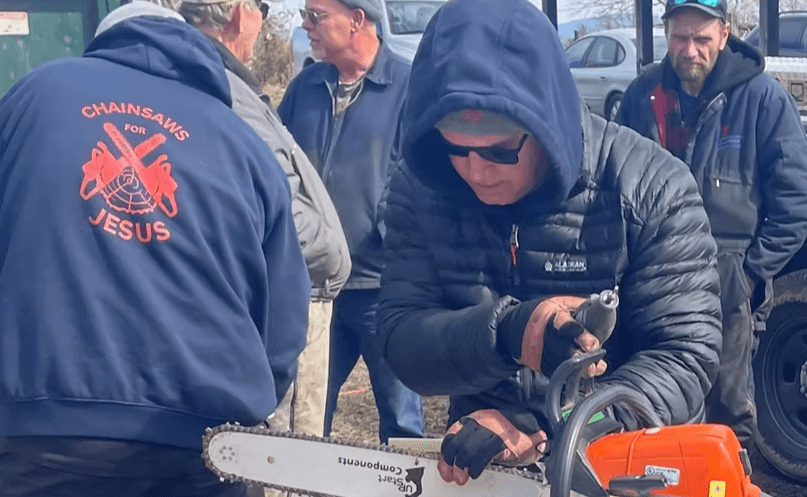
(Nashville, TN) Faith isn’t meant to sit quietly in a pew. Sometimes, it shows up wearing steel-toed boots and carrying a chainsaw.
When storms rip through communities and families are left staring at fallen trees and shattered property, there are people who run toward the devastation instead of away from it. They bring practical help, open hearts—and in the case of Chainsaws for Jesus—freshly sharpened blades.
At the center of this growing ministry is Roberto Vaccaro, though he’s quick to tell you it’s not about him. “I am but a spokesman for a group of guys that love the Lord,” he says. “It’s not about us. It’s about Jesus.”
Chainsaws for Jesus didn’t begin as a grand strategy. It started in the summer of 2022 with a handful of men gathering for Friday morning Bible study in Franklin, Tennessee. The group—six to ten men meeting faithfully in a home—came together through the invitation of Jon Christensen.
They studied Scripture. They prayed. They sharpened one another spiritually—as iron sharpens iron.
Then one day, Jon did something unexpected.
After a tornado struck Mississippi, he loaded up his pickup truck and drove into the devastation with a simple idea: offer to sharpen chainsaws for storm victims clearing debris. No nonprofit status. No official plan. Just a prompting.
He returned with stories that stirred something in the group. The idea was simple. The need was real. And every step, Roberto says, felt divinely orchestrated.
Fifteen months later, Hurricane Helene would turn that idea into a mission.
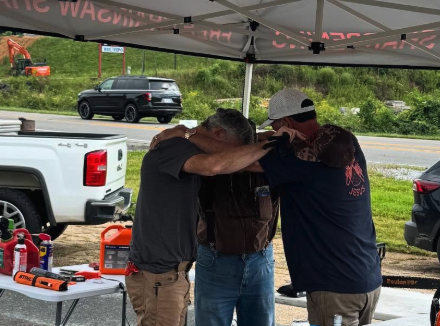
When Helene devastated parts of East Tennessee and North Carolina, the men decided to go—not as individuals, but as Chainsaws for Jesus.
“I had never sharpened a chainsaw before,” Roberto admits with a laugh.
But they showed up anyway.
They were directed—what Roberto calls “divine intervention”—to Spruce Pine, North Carolina. Within 30 minutes of setting up, they saw something that changed them.
Members of the National Guard were standing in line.
Waiting.
For six men from Franklin, Tennessee, to sharpen their chainsaws.
That moment opened their eyes to the scale of the need. But it wasn’t just about tools.
It was about people.
One woman approached them in the middle of her own storm. She was battling a cancer diagnosis when Hurricane Helene destroyed her property and livelihood. The chainsaw sharpening became secondary. What mattered most was the prayer they offered and the reminder that she was not alone.
“We came to love her,” Roberto says. “To pray for her. To share the good news that at the end of the story, we know who wins.”
In the wake of that trip, the mission was galvanized. Since then, the group has responded to 14 to 16 disaster events. Their focus remains clear: sharpen chainsaws, pray with people, plant seeds of hope.
Because someone has to hand you the chainsaw.
And that someone has just lived through tragedy.
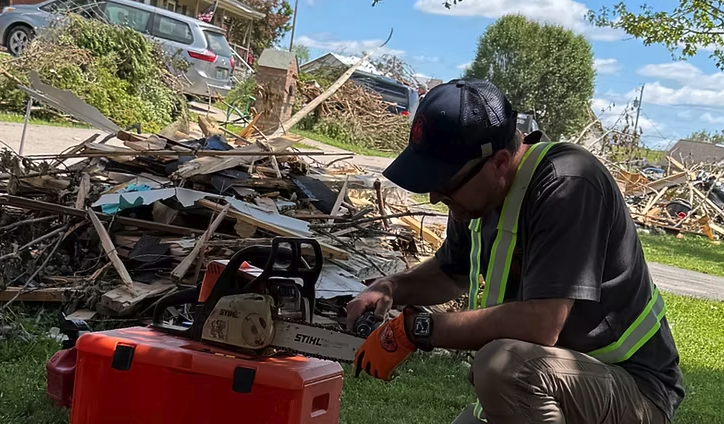
For a long time, Chainsaws for Jesus traveled to other communities. Then the ice storm hit Nashville.
“It sounded like the Fourth of July,” Roberto recalls. “Trees crashing. Branches cracking. It was terrifying.”
For the first time, disaster struck their own backyards. Many of the men had damage on their own properties. Still, they chose to serve.
Within days, they set up at a local church. Then a nationally recognized hardware store offered its parking lot. Over five or six days—while balancing full-time jobs—they sharpened more than 800 chainsaws.
One day alone, they sharpened over 200.
The destruction across Nashville was overwhelming. So was the response. They’re now operating satellite locations to meet the demand.
The ministry may be simple, but its impact is anything but.
On average, it takes five to ten minutes to sharpen a chainsaw. Some people bring one saw. Others show up with bags of chains—eight or ten at a time—worn down from hours of cutting through fallen trees.
But the most powerful moments don’t happen at the grinder.
They happen face to face.
One elderly man arrived early one morning, before the group officially opened. After his chains were sharpened, Roberto asked if he could pray for him.
The man began to cry.
Not only had his property suffered severe damage—he had buried his wife of 60 years just one week earlier.
In that parking lot, amid sawdust and storm debris, grief met compassion.
“We told him the Lord loves you,” Roberto says softly. “Jesus loves you. She is in a much better place. He sees you.”
It’s in those moments that the ministry’s true purpose is revealed.
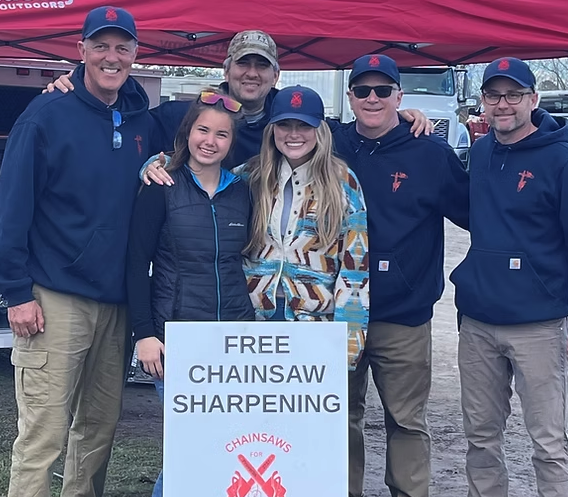
Roberto is the first to admit he’s naturally shy about sharing his faith. But this ministry has changed him.
“We all know the Great Commission,” he says. “We know we’re called to go. This has given me a boldness.”
The men who gather each Friday are not just sharpening chains. They’re sharpening each other. And in the field, they find that something sacred happens—mutual transformation.
“We go out to the field, they sharpen us, we sharpen them.”
Faith becomes active. Tangible. Courageous.
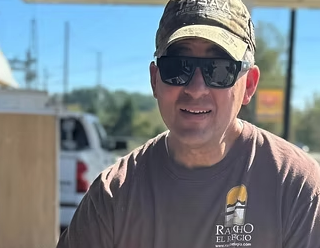
Chainsaws are dangerous tools, and the group has intentionally limited who operates the equipment. But their vision stretches far beyond six to ten men in Tennessee.
“Our vision is to activate a network of servants,” Roberto says.
They’ve already received inquiries from across the country—even the Pacific Northwest—from people who want to replicate the model. The cost of entry is low. The need is high. The reward, they say, is eternal.
At times of crisis, Roberto believes it’s critical for people to see Christians being the hands and feet of Jesus.
Not just talking about love.
Living it.
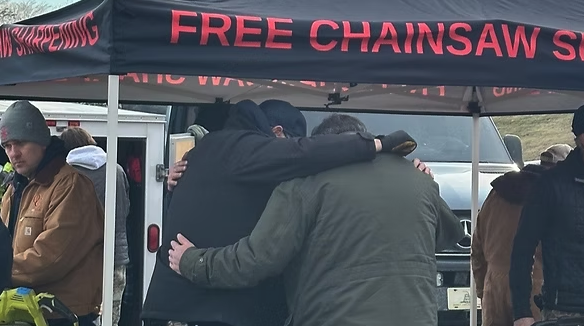
Chainsaws for Jesus updates locations and response efforts through their website and social media, moving quickly when disasters strike. Because storms can’t be scheduled—and neither can compassion.
For Roberto and the men behind the ministry, this is a God thing. A calling that grew from a living room Bible study into a multi-state mission.
“It’s not about us,” he says again. “It’s about sharing Jesus with other folks.”
And sometimes, that sharing begins with a spark, a spinning chain, and a simple question:
“Can I pray for you?”